Reflections and Questions on Revelation
Since I have a flaw in me that makes me like to finish things, especially tasks on a list, I have been working on finishing up some things from last semester, including some Bible study questions from Revelation.
What made me write this post was a question from one of the “Application” sections:
In the Old Testament, the Ark of the Covenant was carried by the people of God into their greatest battles. What are the ways we can carry Mary, the New Ark of the Covenant, with us in the spiritual battles we face today? — Jeff Cavins and Thomas Smith, 34.
Early last week, I had this freaky dream. The dream itself wasn’t particularly scary yet rather intense and bewildering, but believe me when I say that I woke up immediately and could not shake this sense of fear and even a sense of the presence of something evil. So I spoke to my bedroom saying something like, “If there’s anything in here which is not of God, leave now! Because He is more powerful than you and will not let anything bad happen to me!” I felt a little better, but was still uneasy. I started praying a string of Hail Marys, over and over. I peeked into every room in my house, just to make sure things “looked normal.” This is not normal behavior for me.
By the time I came home from work, things were fine. Later in the week, I had a meeting with my spiritual director. She asked if I had had my house blessed (not yet), and suggested that I do so, and also that I speak with one of my pastors because he believes that dreams mean something. I got to talk with him yesterday, and he said that while he didn’t want to place too much emphasis on this, evil was real. Then, he prayed a blessing over me.
Reading the question, I realized that I had been doing that: bringing the new Ark into my spiritual battle. Sadly, I do not yet have the devotion to our Blessed Mother that I would like, but I know that when I am frightened or very sick, I still turn and run to my Mother for comfort. She’s a good one to run to. 🙂
Then I saw a new heaven and a new earth; for the first heaven and the first earth had passed away, and the sea was no more. — Rev. 21:1
I don’t think this means that there will not be a beach or an ocean in Heaven. At least I hope not, since I love to swim! 🙂 I think this was more meant as an idiom, since the sea represented the feared unknown, “Here there be monsters,” and all that. So, with the coming of the new heaven and new earth, there will no longer be any fear or anything which is not known.
Throughout Revelation we have seen many temple furnishings (like the ark and the altar) and the heavenly Temple itself. In God’s new heaven, a temple cannot be found (21:22). What new reality has replaced the image and symbol of a temple? — Jeff Cavins and Thomas Smith, 49.
The Lord Jesus and God the Father are our new temple. We will worship in them and upon their foundation, within their light and place ourselves upon their altar, as a complete gift of ourselves to them.
Here’s another question that I have: the juxtaposition of
they were told not to harm the grass of the earth or any green growth or any tree, but only those of mankind who have not the seal of God upon their foreheads; — Rev 9:4
with
The rest of mankind, who were not killed by these plagues, did not repent of the works of their hands nor give up worshiping demons and idols of gold and silver and bronze and stone and wood, which cannot either see or hear or walk; nor did they repent of their murders or their sorceries or their immorality or their thefts. — Rev 9:20-21.
v. 4 seems to be saying that those who are not marked as belonging to God would be the ones who would experience the plagues. However, v. 20-21 make it seem like the ones who SURVIVED the plagues were those who did NOT follow God. Now, I am confused.
Why Christ crucified?
Jesus crucified. God crucified. I think the emphasis here is because of the assumption of Christianity on the part of Paul’s audience. To emphasize the resurrection would be to try to make a point of His divinity, or at least His favor with God. To emphasize His crucifixion, I think, is to highlight the very first days of the covenant made with Abraham.
And he said to him, “I am the LORD who brought you from Ur of the Chalde’ans, to give you this land to possess.” But he said, “O Lord GOD, how am I to know that I shall possess it?” He said to him, “Bring me a heifer three years old, a she-goat three years old, a ram three years old, a turtledove, and a young pigeon.” And he brought him all these, cut them in two, and laid each half over against the other; but he did not cut the birds in two. When the sun had gone down and it was dark, behold, a smoking fire pot and a flaming torch passed between these pieces. — Genesis 15:7-10, 17
In these days, a covenant was formed in this manner between two peoples, and whoever would violate the covenant would bring about the same fate upon himself as that of the animals cut in two.
And the men who transgressed my covenant and did not keep the terms of the covenant which they made before me, I will make like the calf which they cut in two and passed between its parts — Jeremiah 34:18
So man, as the party who violated the covenant, needed to die because the covenant was broken. In order to fulfill the covenant so that a new covenant could be created, one of the parties needed to die — to fulfill the covenant curse. While we were the ones who deserved death, God died in our stead.
*****
It also points to how we are to live in Christ now. We hope to God’s mercy when we die, so that we may live with Him in His glory forever. But for now, we look to His Son. In particular, we look to His Son on the cross, which is the best example of self-giving love that the world has ever seen. Think not to your own comfort, but give everything for the good of others. Be ridiculed and mocked, so that they can come to know Truth. Allow yourself to be beaten and scourged, so that they can have access to a Love which heals all hurts. Wear their crown of thorns, so that they can have their own minds be filled with Wisdom. Carry for them the dead weight of their troubles and sins. Have your hands and feet be bound to a tree with spikes, so that they can experience freedom. Experience a moment of feeling abandoned by the Father, so that they may know they are never alone. Give up your Spirit, so that they may receive it.
He did not just allow blood to flow from His wounds so as to heal ours, but squeezed out every drop.
This is the kind of life we are called to lead. If God sees to the birds of the air and the lilies in the field, certainly He can take care of our needs; so we have no reason to dwell on our needs, but can look solely to our neighbor in love and ask ourselves, “How can I squeeze out some of my blood on his behalf, to make his lot in life a little easier?” Not a passive bleeding, as in handing over the spare five you happen to have in your wallet, or giving away clothes you don’t wear any more — although these are not bad things to do. But what can you do that will really be a sacrifice? What’s going to make you stop and think about it, and then deliberately decide that the person is far greater and far more worthy than any object, amount of wealth, amount of time, amount of effort that you could possibly relinquish?
And when you have done something really worthy of being called Love, seek out another situation, another person to Love, another instance where you can pour out the blood of your life for someone else.
For your blood is not your own; it is His. Your life is His life in you.
And He wants it to fall upon all His people.
A Density of Questions on 2 Corinthians
Why does Paul use the same word so densely? In the greeting, endurance 10 times? By the end, I have lost all sense of what the word means. And why would boasting be a persuasive argument? It is like advertising? The “superapostles” were going around preaching “Ivory soap — 99.75% pure!”? Paul: “Bah! Mine is 100% pure and more effective to boot!”? Maybe a silly question, but is “boasting in the Lord” similar to “giving witness/testimony” to the way God has worked in your life? With the “no, no,” “yes, yes,” and “yes, no” section (2 Cor 18-19), is this like accusing a politician of “waffling” and thus being untrustworthy?
If people question that 2 Cor could not be one coherent letter because of breaks in theme, tone, etc., they have not read one of my e-mails. LOL! And now to talk about…vegetables…. It’s all related, just maybe not that clear to others, but perfectly okay in my head. I get that. 🙂
Trust
The thing about trust, is that it can be very easy. But for it to be easy, you have to make yourself vulnerable. You have to be willing to be hurt as badly as you were before or worse, again today. There is no “building trust,” because then you subject the other person to trying to “prove” their trustworthiness, and you always keep this seed of doubt within you, looking for “warning signs” of a breach of trust. True trust, I think, is laying yourself bare before the other person and saying, “I *choose* to trust you, unconditionally, regardless of the past. I *give* you the power to hurt me, because I *know* you will not choose to do so.”
Of course, you’d want to be prudent about whom you are giving your trust to…. 🙂
The Lord of Hosts
Today was one of those times where reading different things simultaneously was advantageous. I was reading both the second half of 1 Corinthians and The Lamb’s Supper: The Mass as Heaven on Earth by Scott Hahn. In his book was a section talking about the Lord of Hosts. I stopped reading for a minute and reflected on this title. Usually, I took this to be a Eucharistic title, and kept picturing in my mind the hosts which would be consecrated into the Body of Christ.
But perhaps this is a little simplistic.
Next, I thought about hosts as in the angels and saints who are present worshiping at Mass with us. And this tied in well for me with the text from Corinthians, where Paul talks about all of us being the body of Christ:
As a body is one though it has many parts, and all the parts of the body, though many, are one body, so also Christ. For in one Spirit we were all baptized into one body, whether Jews or Greeks, slaves or free persons, and we were all given to drink of one Spirit.
And this leads me back to the concept of being a host. The unleavened bread is transformed into the Body, Blood, Soul and Divinity of Christ. We become hosts for the indwelling of the Holy Spirit at our baptism.
But with God, it’s not a matter of one of these. With God, it is all of these. Just one resounding “Yes!”
Thanks be to God!
Preists vs. Seminarians Basketball Game 2011
Due to the timing of the game, the crowd was a little less than it had been in previous years, but we still had a fun time watching the Priests play the Seminarians in the annual Sr. Mary Finn Classic. 🙂
I arrived early wearing my inflammatory T-shirt. (“Sacerdotes delent! Scholares modo velint!” which translated is supposed to mean something like, “Priests dominate! Seminarians [students] only hope to!”)
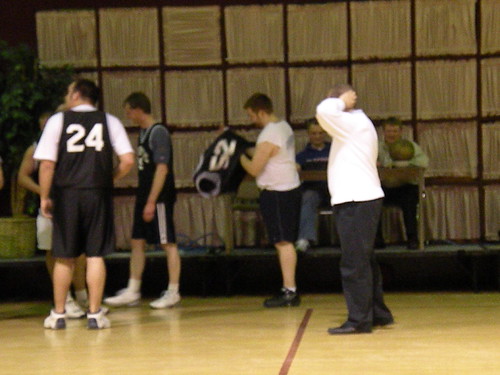
Player #24 is our very own Fr. Mark Prill:

He did a great job of controlling the center court and observing some of the unorthodox soccer moves which were being displayed. 😛
There were many, many fouls called…particularly on the Priests…so we got to see a lot of photos like this:


Some photos of athleticism in action:


At halftime, the evening’s emcee, seminarian Jim Houbeck, spent some time razzing Fr. Mark and even interviewed his parents! 🙂
At which point, Fr. Mark stole the mike and said some words of self defense:

Next, came the tricksy part of the evening. Due to a … scoring deficiency … despite creative scorekeeping efforts … the priests decided to call some seminarians to defect to their side. The new team, with the addition of the 2 deacons, was renamed the Clerics. Here’s the photo evidence of one of the defectors;

At one point, we even tied the game!

The question arose whether it was licit for the Priests to steal team members from the other side.

Dr. Peters ruled in favor of the Priests. 🙂
After the game, Fr. Mark had me lead people up to the bar since “I knew the way.” Well, I found my way into the occupied locker room! I knew one of the doors lead to a stairway…I just picked the wrong one! We did eventually find our way up there.
Shortly thereafter, Jim gave us a tour of the seminary.
Along the way, Jim quizzed us. If we got a question wrong, we owed him 3 Hail Marys. I was not allowed to participate, since I go to school at the Seminary.
We made it back to the bar and hung out for a bit.


The anticipated pizza never arrived, so we concluded the evening by heading out to the Green Lantern for our evening meal.
A Parent’s Heart
My children, for whom I am again in labor until Christ be formed in you! I would like to be with you now and to change my tone, for I am perplexed because of you. (Galatians 4:19-20)
It’s such a hard thing to watch our children grow up, isn’t it? Especially when you see them walking down a dangerous path in their lives. You want to just pick them up and almost live their lives for them, so that they won’t be hurt by what you know is ultimately harmful to them, but that they currently find attractive. The corrections that you give are, indeed, loving, in that they attempt to help your kids back onto a better path. However, sometimes the freedom that you give your children is more helpful. Within limits, it teaches your children not to just “obey Mom’s/Dad’s law,” but to evaluate situations for themselves so as to learn how to live a good life on their own. The rub for parents is that you have to sit back and allow your child to make mistakes and to fall.
We always try to prepare them for the world. To teach them not to talk to strangers. To look both ways before crossing the street. To eat their veggies. To look out for your little brother/sister. To brush your teeth. To say your prayers at night. When they are small, usually they more or less obey, but when they turn into teens and try to determine for themselves their identity…then is when you have the greatest opportunity for rebellion.
What Paul is stating here is the lament of every parent of a teen who has ever said, “I taught you better than that!” or “That’s not who I raised you to be!” or “That’s just not like you!” The formerly sweet, docile child has become somehow something like a child of wrath. A stranger you don’t recognize. The bonds between you which were formerly strong are now a little weaker, a little fainter — distance has set in as friends and culture at large has replaced you as the, apparent, new standard for behavior. What happened?
I think it’s a normal part of the maturation process. At some point, the newly instructed needs to learn to fly on their own. Our rules and teachings have to be incorporated into their hearts, and this can only be done by a free choice of their will.
It is at this point that God’s people are being offered this opportunity to see beyond the Law and fill their hearts with the New Covenant. They are ready for the next step in the maturation process.
In the same way we also, when we were not of age, were enslaved to the elemental powers of the world. But when the fullness of time had come, God sent his Son, born of a woman, born under the law, to ransom those under the law, so that we might receive adoption. (Galatians 4:3-5)
Non Sequitur:
The photo is me as a toddler. As the story goes, I was being a pill when my parents took me to the park this day, so they stuck me in a waste basket and started walking away…. 🙂
The Lord’s Passion
The following is a quote from the book “I Don’t Have Enough Faith to Be an Atheist,” by Norman Geisler and Frank Turek. It is a graphic and disturbing description of the Lord’s Passion. For me, this is a great passage to reflect upon and pray with, especially as we draw closer to Lent.
The whip the Roman soldiers use on Jesus has small iron balls and sharp pieces of sheep bones tied to it. Jesus is stripped of his clothing, and has his hands tied to an upright post. His back, buttocks, and legs are whipped either by one soldier or by two who alternate positions. The soldiers taunt their victim. As they repeatedly strike Jesus’ back with full force, the iron balls cause deep contusions, and the sheep bones cut into the skin and tissues. As the whipping continues, the lacerations tear into the underlying skeletal muscles and produce quivering ribbons of bleeding flesh. Pain and blood loss set the stage for circulatory shock.
When it is determined by the centurion in charge that Jesus is near death, the beating is finally stopped. The half-fainting Jesus is then untied and allowed to slump to the stone pavement, wet with his own blood. The Roman soldiers see a great joke in this provincial Jew claiming to be a king. They throw a robe across his shoulders and place a stick in his hand for a scepter. They still need a crown to make their travesty complete. A small bundle of flexible branches covered in long thorns are plaited into the shape of a crown, and this is pressed into his scalp. Again there is copious bleeding (the scalp being one of the most vascular areas of the body). After mocking him and striking him across the face, the soldiers take the stick from his hand and strike him across the head, driving the thorns deeper into his scalp.
Finally, when they tire of their sadistic sport, the robe is torn from his back. The robe had already become adherent to the clots of blood and serum in the wounds, and its removal — just as in the careless removal of a surgical bandage — causes excruciating pain, almost as though he were being whipped again. The wounds again begin to bleed. In deference to Jewish custom, the Romans return his garments. The heavy horizontal beam of the cross is tied across his shoulders, and the procession of the condemned Christ, two thieves, and the execution party walk along the Via Dolorosa. In spite of his efforts to walk erect, the weight of the heavy wooden beam, together with the shock produced by copious blood loss, is too much. He stumbles and falls. The rough wood of the beam gouges into the lacerated skin and muscles of the shoulders. He tries to rise, but human muscles have been pushed beyond their endurance. The centurion, anxious to get on with the crucifixion, selects a stalwart North African onlooker, Simon of Cyrene, to carry the cross. Jesus follows, still bleeding and sweating the cold, clammy sweat of shock.
The 650-yard journey from the fortress of Antonia to Golgotha is finally completed. Jesus is again stripped of his clothes except for a loincloth which is allowed the Jews. The crucifixion begins. Jesus is offered wine mixed with myrrh, a mild pain-killing mixture. He refuses to drink. Simon is ordered to place the cross beam on the ground, and Jesus is quickly thrown backward with his shoulders against the wood. The legionnaire feels for the depression at the front of the wrist. He drives a heavy, square, wrought-iron nail through the wrist and deep into the wood. Quickly, he moves to the other side and repeats the action, being careful not to pull the arms too tight, but to allow some flexibility and movement. The beam is then lifted, and the title reading “Jesus of Nazareth, King of the Jews” is nailed in place.
The victim Jesus is now crucified. As he slowly sags down with more weight on the nails in the wrists, excruciating, fiery pain shoots along the fingers and up the arms to explode in the brain — the nails in the wrists are putting pressure on the median nerves. As he pushes himself upward to avoid this stretching torment, he places his full weight on the nail through his feet. Again, there is the searing agony of the nail tearing through the nerves between the metatarsal bones of the feet. At this point, another phenomenon occurs. As the arms fatigue, great waves of cramps sweep over the muscles, knotting them in deep, relentless, throbbing pain. With these cramps comes the inability to push himself upward. Hanging by his arms, the pectoral muscles are paralyzed, and the intercostal muscles are unable to act. Air can be drawn into the lungs but it cannot be exhaled. Jesus fights to raise himself in order to get even one short breath. Finally, carbon dioxide builds up in the lungs and in the bloodstream, and the cramps partially subside. Spasmodically, he is able to push himself upward to exhale and bring in life-giving oxygen. It is undoubtedly during these periods that he utters the seven short sentences that are recorded.
Now begins hours of this limitless pain, cycles of cramping and twisting, partial asphyxiation, searing pain as tissue is torn from his lacerated back as he moves up and down against the rough timber. Then another agony begins. A deep, crushing pain in the chest as the pericardium slowly fills with serum and begins to compress the heart. It is now almost over — the loss of tissue fluids has reached a critical level; the compressed heart is struggling to pump heavy, thick, sluggish blood into the tissues; the tortured lungs are making a frantic effort to gasp in small gulps of air. The markedly dehydrated tissues send their flood of stimuli to the brain. His mission of atonement has been completed. Finally he can allow his body to die. With one last surge of strength, he once again presses his torn feet against the nail, straightens his legs, takes a deeper breath, and utters his seventh and last cry: “Father, into your hands I commit my spirit.”
Save Me from the Stupid: Flirting with Sin
Paul says a lot of great things. Like this:
Are you so stupid? After beginning with the Spirit, are you now ending with the flesh? (Galatians 3:3)
This “stupid” is a harsh rebuke, referring to one who does not see reality. And, isn’t this our internal cry to ourselves every time we become aware of our sin? Why did I do that? I know better! UGH!
But how easy is this, if we are not vigilant against the temptations of the culture in which we live? Everything we are exposed to tells us that we are to indulge. It’s not about liberty, but license, with the small caveat that your license does not harm or interfere with certain other’s rights.
In my baptism, I died to sin and rose to new life in Christ. Why then, do I still fall? Why do I still see things as harmless or fun or appealing even after having a new heart created within me and God’s own Spirit dwelling within me?
I think it’s because I am stupid. I do not clearly see the reality that is before me. If I truly understood, I would be different. But as it is, there is something like blinders on. I have that tendency to sin, that limp in my walk that makes me prone to tripping.
Ask my mom — ask anyone — I have this rebellious streak in me that likes to test boundaries; I think perhaps we all do to a degree. And it is so easy to rationalize things and lead ourselves into increasingly greater sin.
It starts with the smallest things. A glance, perhaps. A flirtatious smile. A change in posture. You feed off the response of the person you are engaging. Maybe now some double entendres. Suggestive speech. Slightly dirty jokes. Harmless, right?
But even right there, we need to stop ourselves. Just in the beginning, we need to see what we are doing and where it is leading. Why am I flirting with this guy? Do I really want to try and attract him to me? Or am I just doing it because it’s fun to elicit a response? Where will I draw the line with my suggestive speech and behaviors? Am I leading this other person into sin?
I’m playing with fire, and now I’m not only sprinkling myself with propellant, but also you. Trying to see how long we can play with the flames before we get burned. Objectification of another person comes swiftly and insidiously. I may not think it’s a big deal. You may like it. But it isn’t consonant with our nature as humans. You deserve better. You are a precious gift. And so am I.
The point is not that we are so bad. The reality is that we have been made so good and need to learn to live as such.
When I objectify you or myself, I am making you (or me) into something less than human — a thing, a toy. My vision isn’t narrowed when I turn away from the norms of the culture; it’s widened and clarified.
Help me, Lord, to learn to be authentically human and to love others with Your love. Please send me Your Spirit to help me see clearly.